


Our Pricing Approach
Pricing is about understanding the value you create, how customers experience that value, and designing a model that holds up as the venture grows. Our practical approach to pricing AI platforms removes guesswork and gives you a foundation to build on with confidence.
The right pricing strategy sits at the intersection of value, positioning, and real-world usage.
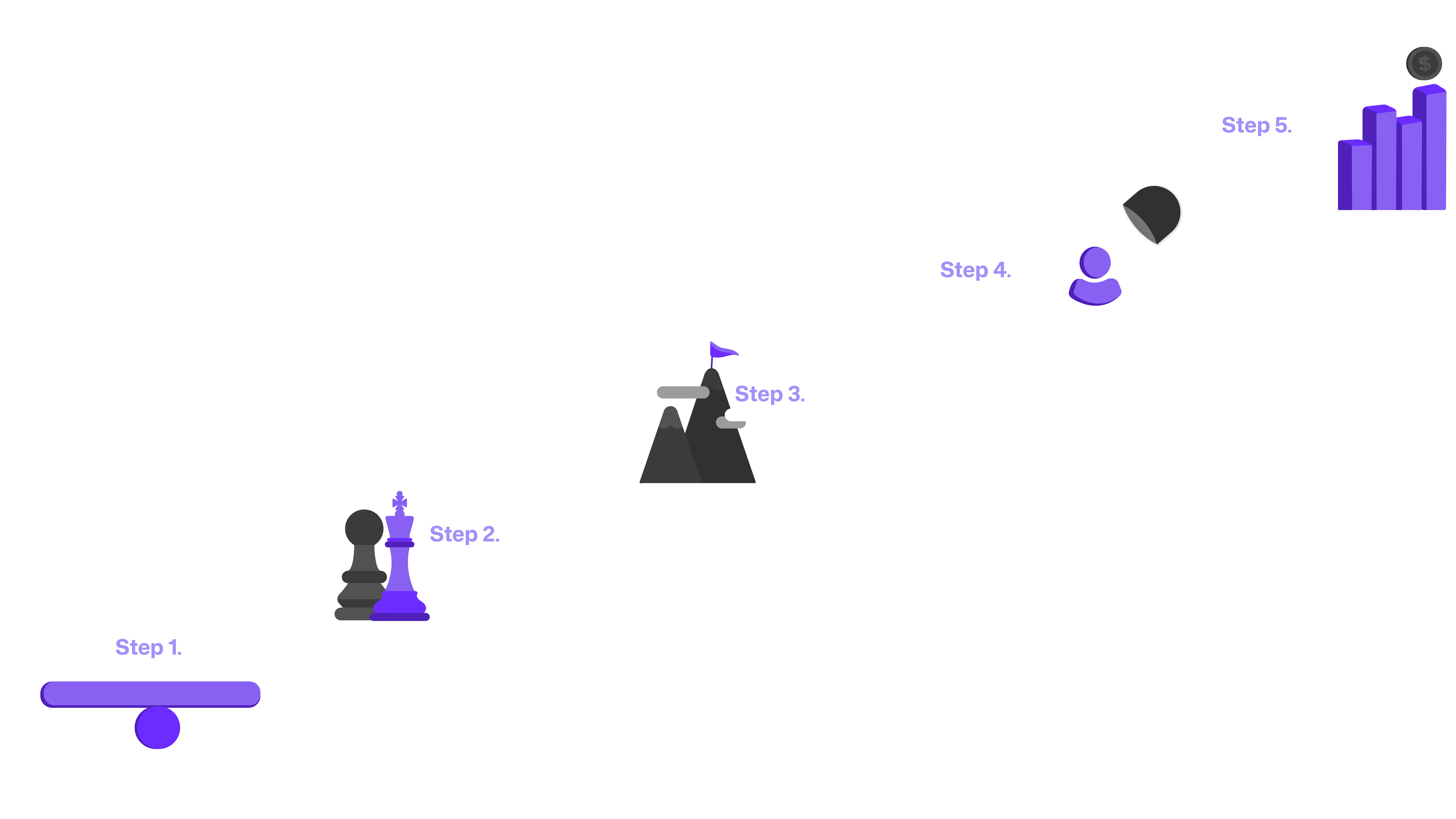
Our approach breaks pricing down into clear steps: quantifying impact, benchmarking alternatives and designing models that reflect how customers will actually use the platform.
We start by identifying the value the platform delivers to the customer.
This may include:
- Time saved through automation
- Improvements in accuracy or quality
- Reduction in operating or compliance costs
- Risk reduction or error prevention
- Revenue uplift or productivity gains
By grounding pricing in tangible outcoms, we establish a value anchor that pricing decisions can be tested against. This ensures the platform is commercially justifiable from the customer’s perspective.

Next up, we analyse how the problem is being solved today, and what customers are already paying.
This includes:
- Manual processes and internal labour costs
- Legacy or incumbent software solutions
- Workarounds and fragmented tools
- Comparable AI or SaaS platforms
These benchmarks define the realistic price boundaries and help avoid pricing models that are either uncompetitive or misaligned with market expectations.

Pricing can’t be separated from positioning. We determine where the platform should sit in the market:
- Specialist vs horizontal solution
- Premium vs deliberately accessible
- Category leader vs focused point solution
This positioning shapes not only price levels, but how pricing is framed, justified and understood.


With value and benchmarks in place, we focus on the customer: how they experience the problem, how strongly they feel it, and their willingness to pay.
We assess price sensitivity by understanding whether the problem is a minor inconvenience or a meaningful operational, financial, or risk-related issue - and whether the buyer feels that pain directly or indirectly within the organisation.
These insights guide entry pricing, tiering, and how value is captured across different customer segments.

With clarity across value, positioning and customer behaviour, we establish indicative price ranges early.
Most AI ventures benefit from a mix of subscription and usage-based pricing.
We design models that reflect how customers actually use the platform, commonly including:
- Monthly or annual licences
- Usage-based components linked to AI consumption
- Tiered plans based on features or scale
- Per-organisation, per-user or per-seat structures
The goal is to keep pricing simple to understand, while allowing it to scale naturally as value increases.

Unlocking multiple revenue streams
Beyond standard base subscription model, many AI platforms create value in more ways than one.
We look for opportunities to unlock additional revenue streams that align with how the platform is used and where value is delivered.
Depending on the venture, this may include:
- Usage-based or consumption pricing layered on top of subscriptions
- Premium features or advanced analytics tiers
- Enterprise plans with custom integrations or service levels
- Implementation, onboarding or configuration fees
- Add-ons for compliance, reporting or industry-specific modules
- Data, insights or benchmarking products derived from platform usage
By designing these early, we ensure revenue can grow with adoption, without relying on a single pricing lever or reworking the model again.


Who we are
Here to turn your AI idea into an industry transforming venture
Mayfly helps you turn your AI idea into an industry-transforming venture.
As a venture studio, we bring product insight, go-to-market strategy, technical execution, and network into one integrated team, with shared ownership from the start.
We partner closely with a select group of ventures, validating what matters, reducing risk early, and giving founders clarity and confidence at every stage.

Build your strategic roadmap
Uncover the risks, commercial opportunity and strategy for success so you can build your venture with clarity and confidence.
$15,000
UVP
- UVP Definition
- Customer Discovery
- Problem/ Solution Analysis
- Competition Analysis
GTM
- Phased GTM Roadmap
- Channel discovery
- Funnel Design
- Messaging framework
- Business Model Strategy
Product
- Phased Product Roadmap
- Product Scope and Quote
- Product Hypothesis
- User Journey Mapping
Bring your idea to the table
Book a complimentary strategy session with our team
If you’re an industry expert thinking about how AI could genuinely improve the way things work in your field, we’d love to hear about it.
The first discussion is simply a chance to talk through the opportunity, find some clarity, and see if there’s a fit on both sides. Early ideas are welcome.
FAQs
Evaluating willingness to pay begins with understanding your ICP through customer interviews, surveys, and feedback loops. Techniques like conjoint analysis or willingness-to-pay surveys can help gauge the price elasticity of your product.
In the early stages, subscription-based pricing with tiers based on seats, usage volume, and monthly or annual billing is often the easiest model to implement, providing predictable revenue. Usage-based pricing can protect against power users if your platform involves heavy AI compute or variable costs.
Several factors influence pricing decisions: your value proposition, competitor pricing, market demand, cost structure (development, operational, and profit margin considerations), and your adoption strategy (introductory pricing vs. premium pricing from the start).
Setting the right price involves understanding your ICP's willingness to pay and the value your AI platform delivers. We recommend starting with a lower price to attract early adopters and then adjusting as you gather feedback and validate product-market fit.
Tracking the success of a pricing strategy involves collecting data and user feedback, particularly understanding whether cost is a blocker to adoption or a driver of churn. Pricing strategy should adapt over time to balance customer satisfaction and profitability.
Pricing and business model strategy are integral parts of the GTM strategy and must align with your product positioning and value proposition. Pricing decisions also inform channel selection, messaging, and sales tactics, ensuring alignment across all aspects of your venture strategy.
Yes, we play a key role in helping you define a pricing strategy that aligns with both your product value and market needs. Within the Venture Building Engagement, we offer high-level guidance around the business model, potential revenue streams, and competitive benchmarking rather than exact pricing recommendations.

